numbers and benchmarks
How do I price a five meal weekly family box so it still clears thirty percent food cost?
Build the price from the plate up: costed recipes, yield loss, packaging, labor per pan and delivery. A worked example for a five entree box serving a family of four.
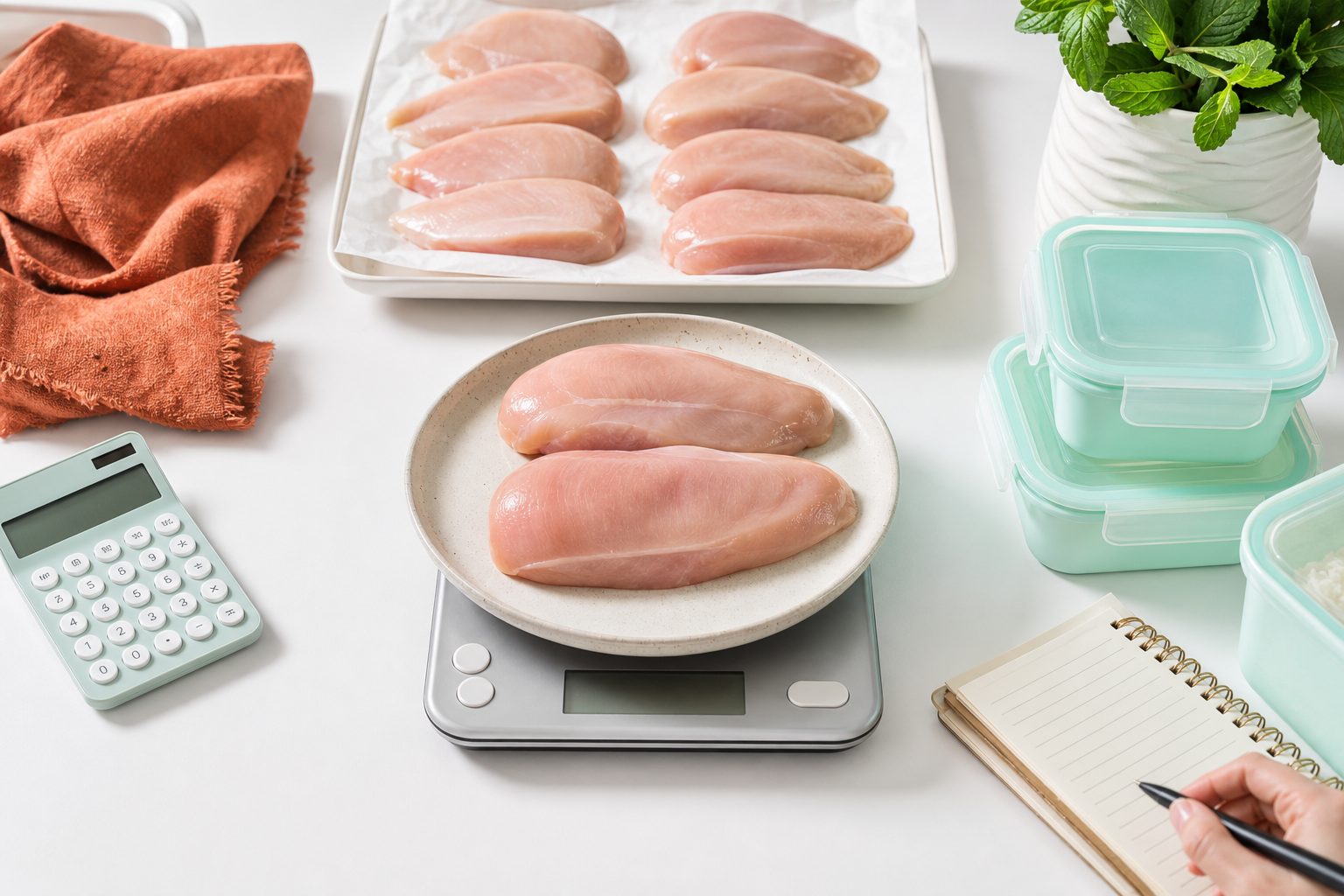
Work backward, not forward. If you want a thirty percent food cost, the box price is your total costed ingredient spend for five entrees divided by 0.30. Cost five family sized entrees at, say, 15.60 in edible portion ingredients and the box has to sell at 52 dollars to hit the target. Everything else you spend, containers, labels, labor, fuel, comes out of the remaining 70 percent, not out of the food number.
The reason so many meal prep kitchens miss the target is not that they priced too low in the abstract. It is that they costed the wrong weight. A recipe that calls for two pounds of chicken breast does not consume two pounds of purchased chicken breast. It consumes closer to two and a half once you account for trim and cook loss, and that gap is where the margin goes.
What follows builds a real box price from the plate up, with the arithmetic shown so you can swap in your own invoice numbers.
Costing a recipe by yield, not by raw purchase weight
Every ingredient has two prices. The as purchased price, what your invoice says per pound, and the edible portion price, what the usable weight actually costs you after you have thrown some of it away. The relationship is simple:
Edible portion cost per pound = as purchased cost per pound divided by yield percentage.
Buy a case of boneless skinless chicken breast at 3.20 a pound and trim it to 92 percent usable. Your real cost is 3.20 divided by 0.92, which is 3.48 a pound. That eight percent looks like nothing until you multiply it across every protein line in a forty box week.
Do this for the ingredients that carry weight and dollars. Proteins first, then produce you peel or stem, then cheese you shred yourself. Do not bother building yield factors for salt, dried oregano or a splash of vinegar. Cost those as a flat spice and pantry allowance per batch and move on.
Keep reading: How many pounds of chicken should I thaw for forty orders without wasting a case?
Where trim loss and cook loss quietly move your plate cost
Trim loss and cook loss are two separate deductions and both apply. Trim happens cold, at the board. Cook loss happens in the oven or the kettle, mostly as water and rendered fat. Stack them in order.
Take a chicken and broccoli bake with a stated cooked portion of six ounces of chicken per family serving of four, so 24 ounces of cooked chicken per pan.
- Cooked chicken needed per pan: 24 ounces.
- Cook yield on roasted breast, assume 75 percent. Raw trimmed needed: 24 divided by 0.75 equals 32 ounces, or 2 pounds.
- Trim yield, assume 92 percent. Raw as purchased needed: 32 divided by 0.92 equals 34.8 ounces, call it 2.18 pounds.
- At 3.20 as purchased per pound: 6.98 of chicken in that pan.
Cost the same pan off the recipe card at 2 pounds and you write down 6.40. The 58 cent gap per pan is 23.20 across forty boxes, every single week, on one component of one entree. Those yield percentages are assumptions. Test them once in your own kitchen by weighing a pan before and after, and use your own numbers from then on.
Packaging, labels and the freezer bag line item people forget
Packaging is not food cost. It belongs in its own line, and it is bigger than most operators guess because a frozen box has more components than a hot delivery.
| Component | Assumed unit cost | Per box of five |
|---|---|---|
| Family size container with lid | 0.62 | 3.10 |
| Printed label, ingredients and allergens | 0.09 | 0.45 |
| Heating instruction card | 0.05 | 0.25 |
| Insulated tote liner, amortized | 0.40 | 0.40 |
| Gel pack, amortized over reuse | 0.35 | 0.35 |
| Outer bag or box | 0.55 | 0.55 |
| Total | 5.10 |
Those are illustrative unit prices, not quoted ones. Replace them with your own supplier sheet. The point is the shape: packaging lands somewhere near ten percent of a fifty dollar box, which is on par with what many kitchens assume for their entire non food cost. If your tote and gel packs come back, amortize honestly by assuming a return rate rather than a full recovery.
Keep reading: What actually has to go on my frozen meal label before it leaves my kitchen?
Labor per batch versus labor per portion as batches grow
Labor does not scale linearly, and that is the single best argument for a fixed weekly menu. Prep labor has a setup component that is nearly the same whether you make eight pans or thirty.
Assume a fully loaded labor rate of 22 dollars an hour, wages plus payroll taxes. A chicken and broccoli bake breaks down roughly as:
- Mise en place and setup: 25 minutes, fixed per recipe.
- Trim and portion: 0.9 minutes per pan, variable.
- Assembly and pan up: 1.6 minutes per pan, variable.
- Label, seal and freeze: 0.7 minutes per pan, variable.
- Break down and sanitize station: 15 minutes, fixed.
At 10 pans: 40 fixed minutes plus 32 variable equals 72 minutes, 7.2 minutes per pan, or 2.64 in labor each. At 40 pans: 40 fixed plus 128 variable equals 168 minutes, 4.2 minutes per pan, or 1.54 each. Growing that recipe from ten to forty pans took 1.10 per pan out of your cost without touching a single ingredient price.
This is why cutting the menu from nine choices to five usually makes more money than negotiating with a distributor. Fewer recipes means fewer fixed setups spread over more pans.
Delivery and fuel inside the box price or charged separately
Both work. What does not work is absorbing delivery invisibly and then wondering why margin sags on the weeks you drove furthest.
Cost a route the way a carrier would. Assume a 42 mile Tuesday loop, 2.9 hours door to door including load out, at 22 an hour fully loaded, plus a vehicle cost of 0.55 a mile covering fuel, insurance and wear. That is 63.80 in time plus 23.10 in vehicle, so 86.90. Deliver 22 boxes on that route and delivery costs 3.95 a box. Deliver 12 and it costs 7.24.
The decision rule that follows is clean. If your routes are dense and predictable, fold delivery into the box price and market free delivery inside your zone, because the cost per box is stable. If you serve a wide radius with scattered stops, charge a separate zone based fee, because burying a 7 dollar cost inside a 52 dollar price quietly deletes a quarter of your gross margin on the far end of the map.
See how FreezerFive handles this for meal prep and freezer meal businesses
Setting the box price backward from a target food cost percentage
Now assemble the whole thing. Five family entrees, edible portion costed, using assumed figures:
| Line | Per box | Percent of price |
|---|---|---|
| Food, edible portion costed | 15.60 | 30.0 |
| Packaging and labels | 5.10 | 9.8 |
| Production labor | 7.70 | 14.8 |
| Delivery, dense route | 3.95 | 7.6 |
| Kitchen rent and utilities, allocated | 4.20 | 8.1 |
| Card processing at 2.9 percent plus 0.30 | 1.81 | 3.5 |
| Total cost | 38.36 | 73.8 |
| Price | 52.00 | 100 |
| Contribution | 13.64 | 26.2 |
Forty boxes a week at 13.64 is 545.60 in weekly contribution, before your own salary and before insurance, software, marketing and accounting. Look at that number honestly. If your fixed overhead is 1,400 a month, you clear roughly 780 a month at forty boxes. That is not a business yet. It is the shape of one, and it tells you the real question is volume per route, not another twenty cents off the chicken.
Reading your own numbers after four weeks and adjusting
Theoretical food cost is what your recipes say you should have used. Actual food cost is what your invoices and inventory say you did use. The gap between them is the only number that improves anything.
Run it monthly: opening inventory at cost, plus purchases, minus closing inventory, equals food used. Divide by food sales for the same period. If your recipes predict 30 percent and you land at 35, that five point gap on 8,000 in sales is 400 dollars, and it lives in one of four places.
- Over portioning. Weigh ten random pans off the line against the spec. This is the usual culprit.
- Yield drift. A new chicken supplier with a wetter pack changes your cook yield without warning.
- Waste and spoilage. Product thawed for a Thursday run that never happened.
- Price creep. Costed in February, still selling at the February price in August.
Re cost your five highest volume recipes every quarter, and any recipe whose main protein has moved more than ten percent on invoice. Everything else can wait.
Putting the math where the orders are
None of this survives contact with a busy Thursday if it lives in a spreadsheet you open once a month. The costing has to sit next to the ordering, so that when twenty six families pick their five entrees, the ingredient quantities and the plate cost fall out of the same set of numbers.
That is what FreezerFive does with a weekly menu: orders scale the ingredient list automatically, allergen flags follow each recipe onto the label, the pick list prints for the production day, and deliveries group by neighborhood so your cost per box on the route stays where you costed it. Build the price once, properly, then let the week run against it.
Read also
How many pounds of chicken should I thaw for forty orders without wasting a case?
Thaw math starts with portion weight, multiplies by orders, then adds yield loss and a safety margin. A step by step method plus the refrigerated thaw timing that keeps you legal.
What actually has to go on my frozen meal label before it leaves my kitchen?
Statement of identity, net weight, ingredient list in descending order, allergen declaration, your name and address, plus handling instructions. A line by line label audit you can run today.
Should I deliver my meals myself or hand the routes to a courier service this season?
Own van, contracted courier or customer pickup each carry different cost per stop, cold chain risk and liability. A direct comparison for a kitchen running under two hundred boxes a week.