practical guide
How many pounds of chicken should I thaw for forty orders without wasting a case?
Thaw math starts with portion weight, multiplies by orders, then adds yield loss and a safety margin. A step by step method plus the refrigerated thaw timing that keeps you legal.
Start from the cooked weight on the plate, not the number on the invoice. For forty orders of a chicken entree at six ounces cooked per serving, four servings per family tray, you need 960 ounces of cooked chicken, which is 60 pounds. Divide by a cook yield of 0.75 and you need 80 pounds trimmed. Divide again by a trim yield of 0.92 and you need 87 pounds as purchased. Round up to full case weight and pull 90.
That is the whole method in four lines. The reason it matters is that the intuitive approach, pulling "about a case and a half," is wrong in both directions on different weeks. Under pull and you are defrosting under running water at 4pm with an inspector's least favorite method. Over pull and you have thirty pounds of thawed raw poultry with a three day clock on it and nowhere to go.
Below is the arithmetic in detail, the thaw timing that keeps it legal, and a sheet you can rebuild in five minutes.
Working backward from cooked portion weight to raw purchase weight
There are four numbers in the chain and you need all four written down for each recipe.
- Cooked portion weight. What one person actually gets. Weigh it once, off a finished tray, and record it.
- Servings per tray. Usually four for a family box.
- Cook yield. Cooked weight divided by raw trimmed weight, expressed as a decimal.
- Trim yield. Trimmed weight divided by as purchased weight.
The formula: as purchased pounds = (portion ounces multiplied by servings multiplied by orders) divided by 16, divided by cook yield, divided by trim yield.
Work a second example so the shape is clear. A pulled chicken thigh dish, five ounces cooked per serving, four servings, forty orders. That is 800 ounces cooked, or 50 pounds. Boneless thigh holds moisture better, so assume a cook yield of 0.78: 50 divided by 0.78 equals 64.1 pounds trimmed. Thigh needs more fat pulled, assume a trim yield of 0.88: 64.1 divided by 0.88 equals 72.9 pounds as purchased. Pull 75.
Notice the thigh dish needs fewer pounds despite the heavier trim, because the portion is an ounce smaller. Portion size dominates. If you are trying to move your protein spend, change the portion spec deliberately or add a starch, do not shave the yield assumptions.
Keep reading: What actually has to go on my frozen meal label before it leaves my kitchen?
Yield loss factors for boneless breast, thigh and ground poultry
These are starting assumptions to test against your own product, not published constants. Weigh one batch of each before and after and overwrite them.
| Cut | Assumed trim yield | Assumed cook yield | Combined | Raw AP per lb cooked |
|---|---|---|---|---|
| Boneless skinless breast, roasted | 0.92 | 0.75 | 0.69 | 1.45 lb |
| Boneless skinless breast, poached and shredded | 0.92 | 0.70 | 0.64 | 1.55 lb |
| Boneless skinless thigh, braised | 0.88 | 0.78 | 0.69 | 1.46 lb |
| Bone in thigh, roasted then picked | 0.72 | 0.80 | 0.58 | 1.74 lb |
| Ground chicken, 93/7, browned | 1.00 | 0.75 | 0.75 | 1.33 lb |
| Ground turkey, 85/15, browned | 1.00 | 0.70 | 0.70 | 1.43 lb |
The right hand column is the one to tape inside the cooler door. Multiply cooked pounds needed by that factor and you have as purchased pounds in one step. Sixty pounds of cooked roasted breast times 1.45 is 87 pounds. Same answer as the long way.
Two things move these numbers without telling you. Enhanced or brine injected poultry, sometimes labeled as containing up to a 15 percent solution, cooks off far more weight than an untreated bird. And a change in oven load, thirty pans instead of twelve, will hold more steam and lift your cook yield a point or two. Recheck after a supplier change or a volume jump.
Turning an order sheet into a single pounds needed number
The trap is that forty orders rarely means forty of the same entree. On a five item menu, forty boxes might contain three chicken dishes plus a beef and a vegetarian, and each chicken dish has its own portion spec and its own cut.
Aggregate by cut, not by recipe. The sequence:
- List each menu item ordered, with its count.
- For each, compute cooked pounds needed: portion ounces times servings times count, divided by 16.
- Group by cut. All boneless breast lines together, all thigh lines together, ground separately.
- Multiply each cut's cooked total by its AP factor from the table.
- Round up to whole case or whole bag increments, then note the overage.
A worked week: 18 orders of chicken and broccoli bake at 6 ounces, 11 orders of lemon herb chicken and rice at 5 ounces, both breast. That is 18 times 24 equals 432 ounces plus 11 times 20 equals 220 ounces, so 652 ounces, or 40.75 pounds cooked. Times 1.45 gives 59.1 pounds as purchased. If breast comes in 40 pound cases, you are pulling one and a half cases and you should decide now what the remaining 20 pounds does on Thursday.
Keep reading: Should I deliver my meals myself or hand the routes to a courier service this season?
Refrigerated thaw timing by case and by pan depth
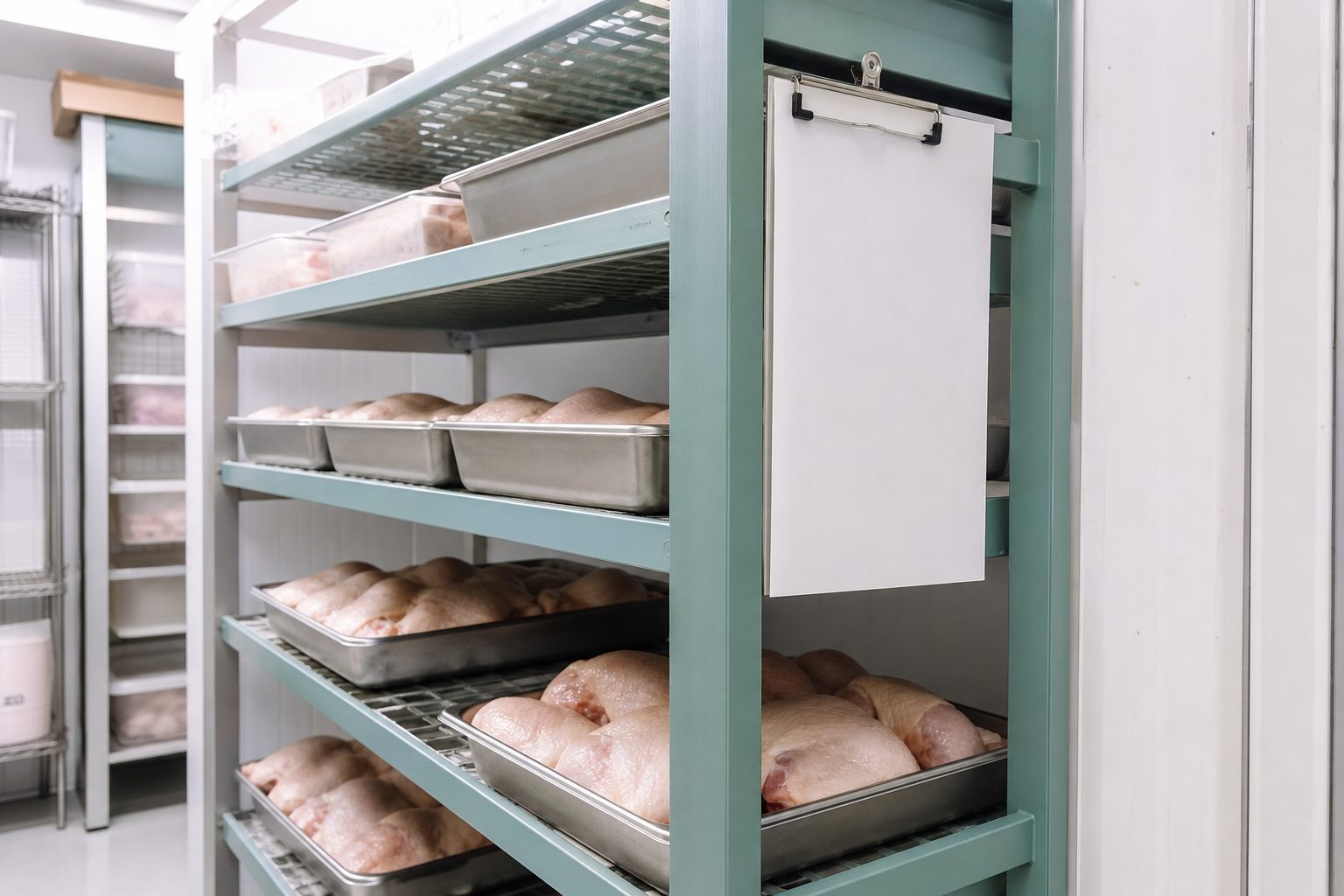
Refrigerated thawing is slow and the mistake is treating it as an overnight job. A solid 40 pound case of frozen breast, still boxed, sitting on a walk in shelf at 38 degrees, can take two to three days to reach a workable state through the center. Broken down onto sheet pans, the same weight thaws far faster because you have collapsed the distance heat has to travel.
Practical planning guidance, to verify against your own cooler:
- Intact case, unopened. Plan 48 to 72 hours. Avoid this entirely if you can.
- Broken into 10 pound bags, single layer. Plan 24 to 36 hours.
- Loose pieces in a two inch pan, single layer. Plan 12 to 18 hours.
- Loose pieces in a four inch pan, piled. Plan 24 hours or more. The center lags badly.
Two inch depth is the workhorse. Deeper pans are how a Wednesday morning production start becomes a Wednesday afternoon one. Thaw pans go on the lowest shelf, in a solid pan with a lip that catches purge, never above ready to eat food. That is not a preference, it is the cross contamination rule inspectors check first.
Approved thaw methods under the FDA Food Code and what inspectors watch
The Food Code, which most states adopt with local amendments, allows four approaches. Know all four and default to the first.
- Under refrigeration at 41 degrees Fahrenheit or below. The default and the only one that needs no supervision.
- Completely submerged under running potable water at 70 degrees Fahrenheit or below, with enough flow to agitate and float off loose particles, and without letting any portion rise above 41 for more than four hours total.
- In a microwave, only when the food goes immediately into continuous cooking.
- As part of the cooking process, going from frozen straight into the oven or kettle with the cook time adjusted.
What gets written up is rarely the method itself. It is the execution: chicken sitting in a prep sink of still water, thaw pans stacked over a container of shredded lettuce, a case thawing on a rack at room temperature because someone needed it by noon. Keep a probe thermometer at the thaw rack and spot check the pans you pulled yesterday. If a pan reads above 41, you are making a disposal decision, not a judgment call.
See how FreezerFive handles this for meal prep and freezer meal businesses
Rolling leftover thawed protein into the next production day safely
You will over pull. The question is what happens next. Once raw poultry is thawed under refrigeration it does not go back to the freezer as raw product for sale, and you should not plan around that.
The two defensible moves:
- Cook it forward. Cook the surplus on the same day to 165 degrees Fahrenheit, cool it through the two stage requirement, then freeze the finished product. Cooking is the reset. A cooked, properly cooled and frozen component has a real shelf life and a place in next week's menu.
- Reassign it same week. Move it into another entree on the current production schedule, tracked on your own date marking so it is used within the window your operation has established for raw thawed poultry, typically the sooner of the manufacturer's use by date or a short in house limit you set and write down.
Date mark the moment it comes out of the freezer, not the moment it finishes thawing. Masking tape and a marker on every pan: cut, weight, date pulled, initials. If it is not marked, it is not usable, and that rule has to be absolute or it will not hold on a busy week.
A repeatable thaw sheet you fill out every week
Same seven columns, printed Sunday night, filled before you leave Monday.
| Cut | Cooked lb needed | AP factor | AP lb | Pull by | Pans | Pulled by / time |
|---|---|---|---|---|---|---|
| Breast | 40.75 | 1.45 | 59.1 | Mon 4pm | 6 x 2in | |
| Thigh | 18.0 | 1.46 | 26.3 | Tue 8am | 3 x 2in | |
| Ground | 12.5 | 1.33 | 16.6 | Tue 2pm | 2 x 2in |
Set the pull by time by counting backward from the production start, using the pan depth timings above, then add six hours of slack. Slack costs you nothing. Being short costs you a whole production block.
Where the sheet should come from
Every number in that table is derived from two things you already have: the orders that came in this week, and the portion spec on each recipe. Recalculating it by hand every Sunday is the kind of task that gets done carefully for a month and approximately forever after.
FreezerFive closes that loop. Customers pick from the weekly menu, the orders scale each recipe's ingredient list automatically, and the pick list comes out with the pounds already summed by cut so you know exactly what to pull and when. Allergen flags ride along to the label, and deliveries group by neighborhood. You still weigh the pans. You just stop doing the arithmetic twice.
Read also
What actually has to go on my frozen meal label before it leaves my kitchen?
Statement of identity, net weight, ingredient list in descending order, allergen declaration, your name and address, plus handling instructions. A line by line label audit you can run today.
Should I deliver my meals myself or hand the routes to a courier service this season?
Own van, contracted courier or customer pickup each carry different cost per stop, cold chain risk and liability. A direct comparison for a kitchen running under two hundred boxes a week.
Why do my customers say the beef comes out watery after they reheat my frozen entrees?
Ice crystal size, sauce thickeners that break, undercooked vegetables and overfilled pans all show up at the customer oven. The freeze side causes and the fixes that hold.