checklist
What actually has to go on my frozen meal label before it leaves my kitchen?
Statement of identity, net weight, ingredient list in descending order, allergen declaration, your name and address, plus handling instructions. A line by line label audit you can run today.
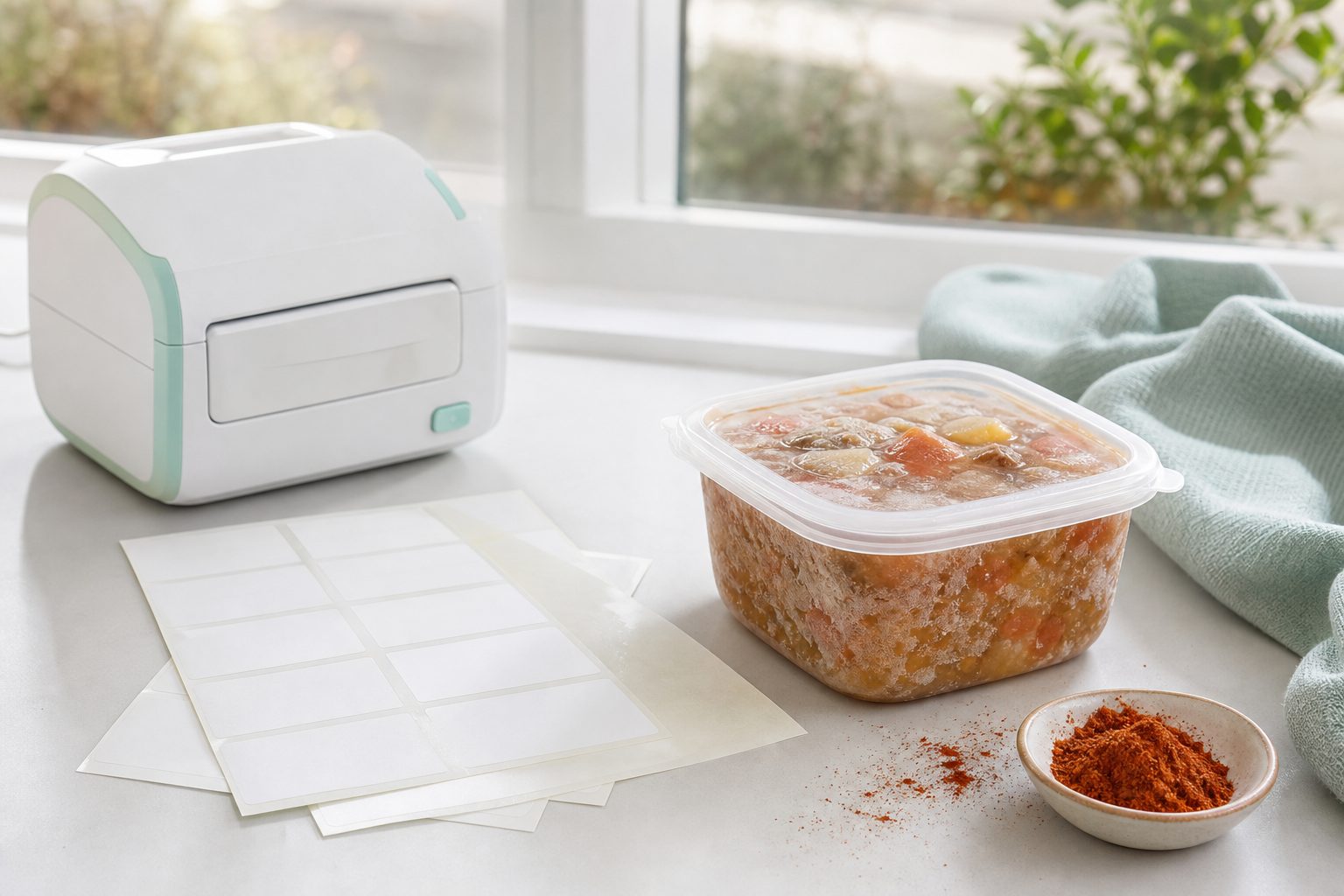
Before a container of your chicken and rice bake leaves your kitchen, its label has to carry five things: a statement of identity that says what the food is, a net quantity of contents, an ingredient statement in descending order of weight, a declaration of any of the nine major allergens, and the name and place of business of whoever made, packed or distributed it. Those five are federal requirements under the Food, Drug and Cosmetic Act and the Fair Packaging and Labeling Act, and they apply whether you print a thousand labels on a commercial press or run them off a desktop thermal printer between batches.
Everything else falls into two buckets. Some of it is a safety statement your product genuinely needs, like KEEP FROZEN and a reheat instruction. Some is state or local. And Nutrition Facts, the panel most small kitchen owners assume is mandatory, is often not required at all for an operation your size. Here is the audit, panel by panel.
The five mandatory panels every packaged food label carries
Label rules split the package into two zones. The principal display panel is the face the customer sees in the tote. The information panel is the one immediately to its right, or the next available surface. Identity and net quantity live on the first. Ingredients, allergens and your name and address live together on the second, with nothing printed in between.
| Element | Where it goes | What trips people up |
|---|---|---|
| Statement of identity | Principal display panel | Common name of the food, bold, sized in relation to the largest print on the panel. "Comfort Bowl" is a fancy name, not an identity. "Chicken and Wild Rice Casserole" is. |
| Net quantity of contents | Lower 30 percent of the principal display panel | Weight, not volume, for a semisolid entree. Customary and metric. |
| Ingredient statement | Information panel | Descending order of predominance by weight, sub ingredients in parentheses. |
| Allergen declaration | Immediately after or within the ingredient statement | Nine allergens, named in plain language. |
| Name and place of business | Information panel | Street address may be omitted only if you are directory listed. |
If your container is a foil pan with a cardboard sleeve, the sleeve is your label. If it is a round tub with a film lid, the lid is usually the principal display panel and a wrap label carries the information panel. Decide which surface is which before you order, because the placement rules follow that decision.
Keep reading: Should I deliver my meals myself or hand the routes to a courier service this season?
Writing an ingredient statement in descending order of weight
You list every ingredient by its common name, heaviest first, using weights as they go into the batch, not as they come out. Two pounds of raw spinach that cook down to a cup still enter the list at two pounds. Work from the scaled batch sheet, convert every line to ounces, sort descending, write it out.
A worked example
Say a 40 portion batch of your beef and barley uses 12 lb beef chuck, 9 lb beef stock, 4 lb carrots, 3 lb onion, 2.5 lb pearl barley, 1 lb tomato paste, 6 oz canola oil, 3 oz kosher salt, 1 oz black pepper. Converted and sorted, the statement opens: Beef, Beef Stock, Carrots, Onions, Pearl Barley (barley), Tomato Paste, Canola Oil, Salt, Black Pepper.
Two rules bite here. A multi component ingredient must be broken out: if that stock is a commercial base, copy its ingredient list into parentheses after it, and pull a current spec sheet, because reformulations go stale on your label silently. And anything under 2 percent of finished weight may be grouped at the end after "Contains 2 percent or less of," which keeps small seasoning changes from forcing a reprint.
The nine major allergens and how to declare them correctly
The list is milk, eggs, fish, crustacean shellfish, tree nuts, peanuts, wheat, soybeans, and sesame. Sesame became the ninth under the FASTER Act, effective January 1, 2023, recent enough that older templates online still show eight.
You have two lawful ways to declare: the plain English name appears in the ingredient statement itself, or you add a Contains statement immediately after it. Most small kitchens use the Contains line because it is easier to proofread. Three specifics catch people:
- Tree nuts and fish must be named by species. "Contains: Tree Nuts" is not enough. Write "Contains: Almonds" or "Contains: Cod."
- The declaration has to match the ingredient list exactly. If Contains says milk and no dairy ingredient appears above it, that is a defect, even though it looks conservative.
- A "may contain" advisory is voluntary and never substitutes for a required declaration. Use it only where cross contact risk is real, otherwise you teach customers to ignore your warnings.
For a kitchen your size the real exposure is not a fine, it is a customer with a peanut allergy eating a Thai curry you swapped from sunflower butter back to peanut butter the week the price moved.
Net quantity of contents and where it must sit on the panel
Net weight excludes the container, the lid, the ice pack and the sleeve. Weigh the filled container, weigh an identical empty one, subtract.
The statement goes in the bottom 30 percent of the principal display panel, parallel to the base, with clear space around it. Pounds and ounces first, metric in parentheses: Net Wt 22 oz (624 g). Over one pound you give both forms: Net Wt 1 lb 6 oz (624 g).
Because fills vary, set your target above your stated weight. If you declare 22 oz and your scale check shows a spread from 21.4 to 23.1, you are shipping underweight packages. Pick the declared weight so your realistic low fill still clears it, and record a scale check on a few units per batch.
Keep reading: Why do my customers say the beef comes out watery after they reheat my frozen entrees?
Keep frozen and reheating instructions as a safety statement
On a frozen entree the handling instruction is doing real safety work. Print KEEP FROZEN prominently, and give a reheat instruction that ends at an internal temperature, not a clock reading alone.
The endpoint to print is 165 degrees Fahrenheit, held 15 seconds, at the coldest point of the portion. That is the reheating temperature the FDA Food Code sets for previously cooked, refrigerated or frozen ready to eat food. Give time as guidance and temperature as the rule, because ovens lie and portion depths differ.
Good practice: thaw method, oven instruction with a range, microwave instruction if you have tested it, and the temperature endpoint. Bad practice: "Bake 45 minutes." That sentence takes the safety decision away from the person holding the thermometer.
Nutrition facts and the small business exemption thresholds
Nutrition labeling has a small business exemption at 21 CFR 101.9(j)(1), and most weekly meal prep kitchens sit inside it. There are two broad paths: one for a business with low total food sales, and the one most operators use, an annual notice filed with FDA covering a firm under a stated employee count selling under a stated number of units of that product per year. Three things to understand rather than a number to memorize:
- The exemption is per product and per year, and the notice must be refiled annually. It is not a permanent status you claim once.
- It is lost the moment you make a nutrient content claim or a health claim. Print "low sodium," "high protein," "keto friendly" or "only 400 calories" and you have volunteered into full nutrition labeling for that item.
- It does not exempt you from any of the five mandatory elements above. Those apply regardless.
Check the current thresholds against the regulation before you rely on them, and if you are growing fast, model the year you cross out. Nutrition analysis for a twelve item rotating menu is a real line item.
See how FreezerFive handles this for meal prep and freezer meal businesses
Date coding and lot codes that make a recall survivable
Nothing in federal law requires a lot code on most retail food. Print one anyway. It is the difference between pulling one production day and pulling everything you have ever sold.
A workable scheme is production date plus batch plus recipe: 0914-B2-BBQ. What matters is that the code ties to a record showing which supplier lots went into that batch and which customers received it.
The customer facing date is separate. "Best if used by" is a quality date, set by when your own taste tests say the product falls off, not by safety. Say what you mean: Best Quality If Used By, with a note that quality depends on continuous freezing at 0 degrees Fahrenheit.
A print ready checklist before you order a thousand labels
Run this on a printed proof. Screen proofing hides type size problems.
- Statement of identity present, in bold, on the principal display panel, using the common name of the food.
- Net weight in the lower 30 percent, US customary and metric, matched to your actual fill data.
- Ingredients sorted from your current batch sheet, sub ingredients broken out, supplier specs under a year old.
- Contains statement matching the ingredient list exactly, sesame included, tree nuts and fish named by species.
- Name and place of business, with street address unless you are directory listed.
- Ingredients, allergens and business name on one panel with no intervening text.
- KEEP FROZEN, thaw method, reheat guidance, and a 165 degree endpoint.
- Lot code field that your printer can actually vary per batch.
- No nutrient content or health claims anywhere, including the brand name, unless you are prepared to carry Nutrition Facts.
- Any state or local requirement your health inspector has named, in writing, in your file.
- Type legible at arm's length, 1/16 inch minimum for most required text.
- Adhesive rated for freezer temperatures and condensation, tested through a real thaw.
Order 100 first. Run them through a full week, including a customer thaw. Then order the thousand.
Where the label meets the week's orders
Label errors are almost never about ignorance. The recipe changed on Tuesday and the label stock was printed in March. When the ingredient statement comes from the same scaled recipe that produces your pick list, a substitution updates both at once.
That is the connection FreezerFive is built around. Take the week's orders, the system scales every recipe to the portions actually sold, flags the allergens each menu item carries, and prints the pick list beside what you are cooking this week. Set the recipes up once, and the audit above becomes something you run when a recipe changes, not something you hope still holds.
Read also

Should I deliver my meals myself or hand the routes to a courier service this season?
Own van, contracted courier or customer pickup each carry different cost per stop, cold chain risk and liability. A direct comparison for a kitchen running under two hundred boxes a week.
Why do my customers say the beef comes out watery after they reheat my frozen entrees?
Ice crystal size, sauce thickeners that break, undercooked vegetables and overfilled pans all show up at the customer oven. The freeze side causes and the fixes that hold.

How does a small kitchen safely serve a family with a peanut and dairy allergy every week?
Allergen segregation is scheduling, storage and cleaning more than it is recipes. How working kitchens sequence production, verify labels and communicate risk to a repeat allergy household.