case study
How did one kitchen grow from twelve boxes to a hundred without hiring a second cook?
Batch consolidation, a fixed four week menu rotation, sub recipe prep days and a single pick list did most of the work. A close look at what changed and what stayed the same.
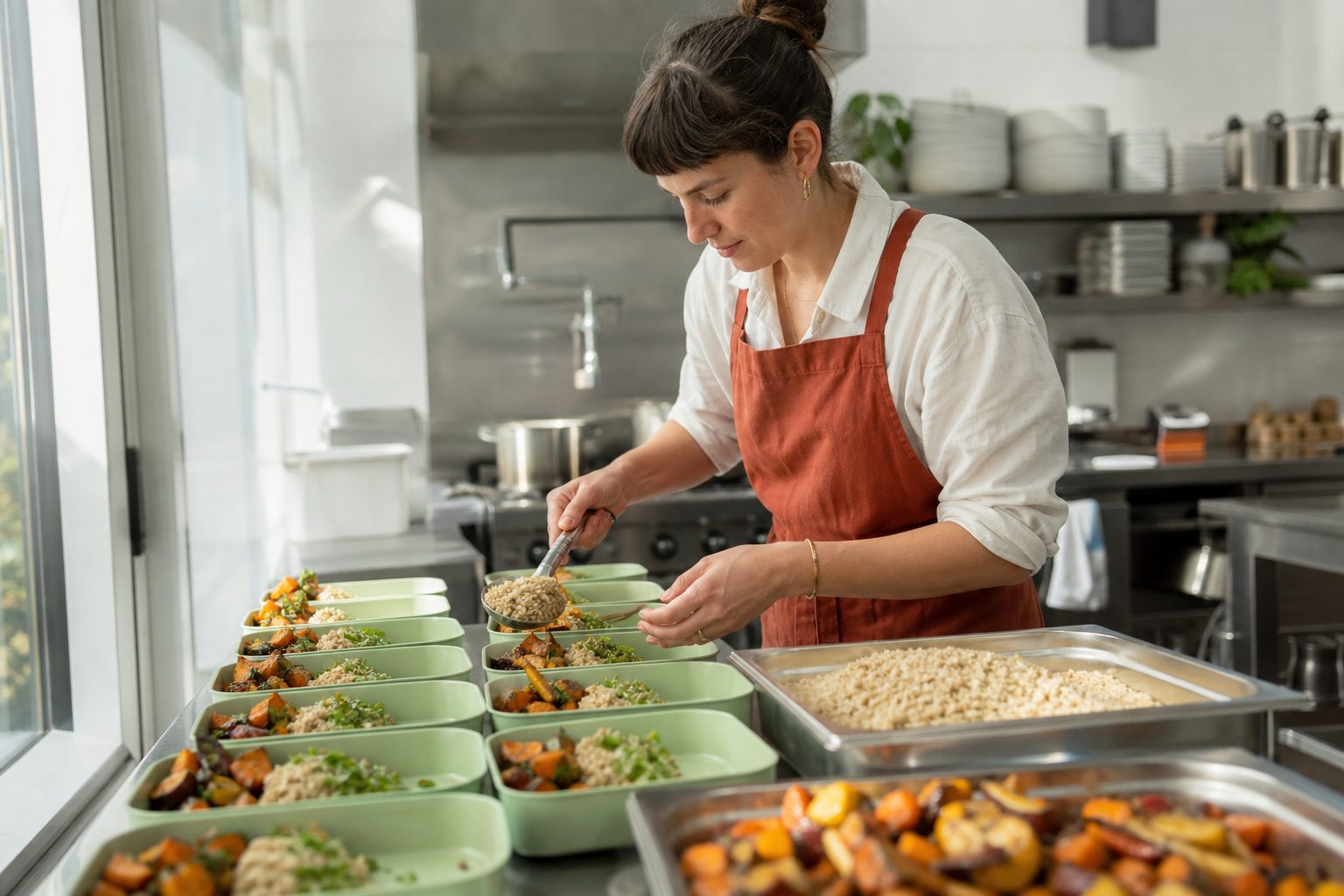
The short answer is that the kitchen stopped cooking a hundred different things and started cooking eight things a hundred times. Nothing about the cook got faster. The work itself changed shape.
Three moves carried almost all of it. A fixed four week rotation replaced a menu written fresh every Sunday. Shared components got pulled out of individual recipes and batched on their own prep day. And the stack of recipe cards on the pass became a single consolidated pick list that told the cook total weights instead of per meal quantities.
Equipment helped at exactly two points and was a waste of money at three others. Here is the whole arc, including the ceiling that eventually forced a hire.
The starting week: twelve boxes, eleven recipes, no repeat items
The first version of this business ran the way most of them do. Customers picked any five meals from a rotating list, the list changed weekly to keep it interesting, and twelve boxes going out meant eleven distinct recipes in a single production day because almost nobody ordered the same thing.
Count what that costs. Eleven recipes means eleven ingredient lists, eleven mise en place setups, eleven pans on and off heat, eleven cleandowns between proteins. Portions were small enough that a two pound batch of a braise took nearly as long as an eight pound batch, because the fixed time is in the knife work, the pan heating, the reduction and the wash, not in the volume.
The cook day ran fourteen hours for twelve boxes. Shopping ran another four because the list was different every week and nothing could be ordered on standing quantities. At sixty meals delivered, that is close to twenty minutes of labor per meal before delivery, which does not work at any price a family will pay.
The diagnosis was not effort. It was variety.
Keep reading: Is demand for weekly freezer meal delivery still growing in mid sized American towns?
Cutting the menu to a four week rotation with shared components
The rebuild started with a blank sheet and one rule: every week's menu must be knowable a month in advance, and recipes must be chosen to share their parts.
Eight core dishes per week, rotating on a four week cycle, so a customer sees a repeat once a month rather than never. Customers who worried about boredom largely did not notice, because a month is long enough that a dish feels welcome rather than repetitive. A handful cancelled. Far more stayed, because consistency meant the thing they liked came back.
Designing for shared parts
The menu was then edited so the eight dishes overlapped deliberately.
- One roasted vegetable mix served three dishes: a grain bowl, a pasta bake and a side with the chicken.
- One tomato base became marinara, a shakshuka style braise and the sauce under a meatball tray.
- One cooked grain, seasoned neutrally, went into two bowls and a stuffed pepper.
- Two proteins covered five of the eight dishes, so the walk in held fewer partial cases.
That last point matters more than it sounds. Fewer distinct ingredients means larger buys on each one, which means better case pricing, less spoilage on the tail of a case, and a shopping list that is nearly identical every fourth week.
Sub recipe days: sauces, grains and roasted vegetables in bulk
With shared components identified, the calendar split in two. One day makes parts. One day assembles meals.
Sub recipe day produces the tomato base, the grains, the roasted vegetable mix, the two brines or marinades and any dressing, all at full weekly volume, in the largest vessel the kitchen owns. These hold well: a cooked tomato base is stable for several days refrigerated, and grains and roasted vegetables chill down and reheat into a finished dish without falling apart.
Assembly day then becomes a different kind of work. Proteins get cooked, components come out of the walk in already made, trays get filled, and the line runs in one direction instead of ten.
The arithmetic that made it obvious
Take the roasted vegetable mix, and assume it appears in three dishes at eight ounces per portion. These are assumptions from one kitchen, not a benchmark.
| Per recipe, three times | Batched once | |
|---|---|---|
| Knife work | 20 min x 3 = 60 min | 45 min |
| Oven setup and load | 10 min x 3 = 30 min | 15 min |
| Roast time, cook attending | partial, 3 separate windows | one window |
| Pans washed | 6 | 4 |
| Cook labor | about 90 min | about 60 min |
Thirty minutes saved on one component. Do that across five shared components and the day is shorter by two and a half hours before anything else changes. Scaling the knife work is not free, which is why the batched figure is 45 minutes rather than 20, but it is sublinear, and that is the entire principle.
Keep reading: Do I need a commercial kitchen license to sell frozen family meals from my home state?
Moving from recipe cards to one consolidated pick list
The last piece of chaos was the paper. Recipe cards tell you what one dish needs. They do not tell you what the day needs.
A cook working from cards ends up doing arithmetic on the floor: seventeen orders of the chicken bowl at six ounces, plus nine of the chicken pasta at five ounces, times a yield factor for trim and cook loss. That math gets done under time pressure, gets done wrong occasionally, and gets redone every single week.
The consolidated pick list inverts it. Orders come in, quantities multiply out, and the sheet that reaches the floor says the total: 41 pounds of raw chicken breast to thaw, 22 pounds of onion, 14 quarts of tomato base. One number per ingredient for the whole day.
What changed in practice:
- Thawing became correct. Undercounting chicken on a Sunday is a Monday that cannot start.
- Shopping became one pass against one list, not a card by card walk through the store.
- A helper could pull and weigh ingredients without knowing any recipe.
- Over purchasing dropped, because the list stopped rounding up eleven separate times.
This is the change that most directly bought headroom, because it removed decision making from the busiest hours of the week.
Equipment that removed a bottleneck and equipment that did not
Two purchases genuinely moved the ceiling.
The first was a second full size sheet pan rack and enough pans to fill it, a few hundred dollars total. The oven was never the constraint. Having somewhere to put hot food and somewhere to stage cold food was. A rack is the cheapest capacity in a kitchen.
The second was a blast chiller, which is the expensive one and the one that is not optional past a certain volume. Food safety requires cooling from 135F to 70F within two hours and down to 41F within a total of six. A sheet pan of hot braise in a domestic freezer does not do that, and stacking hot pans in a walk in warms everything else in there. The chiller converted a compliance problem and a quality problem into a fifty minute cycle.
Three purchases did not pay for themselves at this scale:
- A vacuum sealer for tray meals. Slow per unit, and it did nothing that a good lid and a tight freeze did not already do.
- A commercial food processor bought for slicing. It saved knife minutes and added disassembly and wash minutes, close to a wash.
- A second upright freezer purchased before the pick list existed. Once ordering got accurate, the excess inventory it was holding stopped existing.
The pattern is consistent. Equipment that removes a physical constraint pays. Equipment bought to compensate for a planning problem just stores the problem.
See how FreezerFive handles this for meal prep and freezer meal businesses
Where the ceiling moved next and what forced the first hire
A hundred boxes a week with one cook is roughly two long production days plus a prep day, and it holds as long as everything upstream and downstream of cooking is small.
What broke first was not cooking. It was the perimeter: labeling, packing, loading and the delivery run itself. Sticking labels on five hundred containers is over two hours of standing work that requires no skill and cannot be batched away. Driving thirty stops is most of an afternoon.
So the first hire was not a second cook. It was a part time packer and driver, two afternoons a week. That is the cheaper hire, it is easier to train, and it gave back the exact hours that were capping growth. A second cook only becomes necessary when the cook day itself will not fit in a day, which happened much later.
What this kitchen would do differently starting over
Four things, stated plainly.
- Start with the fixed rotation on day one. Unlimited choice was never a selling point customers asked for. It was a habit inherited from restaurants.
- Build the pick list before buying any equipment. Accurate quantities revealed that two of the constraints were imaginary.
- Buy the chiller earlier and the freezer later. Cooling capacity is the real gate. Storage capacity mostly hides poor forecasting.
- Hire for packing before hiring for cooking. Skilled hours should go to skilled work.
None of these are clever. They are all versions of the same idea: decide once, in advance, and let the week execute a plan instead of improvising one.
Where the software fits
The pick list is the hinge in this whole story, and it is the piece that is genuinely painful to maintain in a spreadsheet once the rotation and the order volume are both real.
FreezerFive takes the week's orders against your set menu and does the scaling: totals per ingredient, in the units you buy, on one sheet, with the allergen flags and the delivery groupings attached. You get the sheet that says how many pounds of chicken to thaw, before Sunday rather than during it.
Read also
Is demand for weekly freezer meal delivery still growing in mid sized American towns?
National meal kit brands have retreated from thin markets while local frozen delivery has held ground. What is driving that split and what it means for a kitchen serving one metro area.
Do I need a commercial kitchen license to sell frozen family meals from my home state?
Cottage food laws almost never cover frozen entrees. Here is how state retail food establishment licensing, commissary agreements and shared kitchen leases actually apply to a freezer meal operation.
How do I price a five meal weekly family box so it still clears thirty percent food cost?
Build the price from the plate up: costed recipes, yield loss, packaging, labor per pan and delivery. A worked example for a five entree box serving a family of four.