trends and outlook
Is demand for weekly freezer meal delivery still growing in mid sized American towns?
National meal kit brands have retreated from thin markets while local frozen delivery has held ground. What is driving that split and what it means for a kitchen serving one metro area.
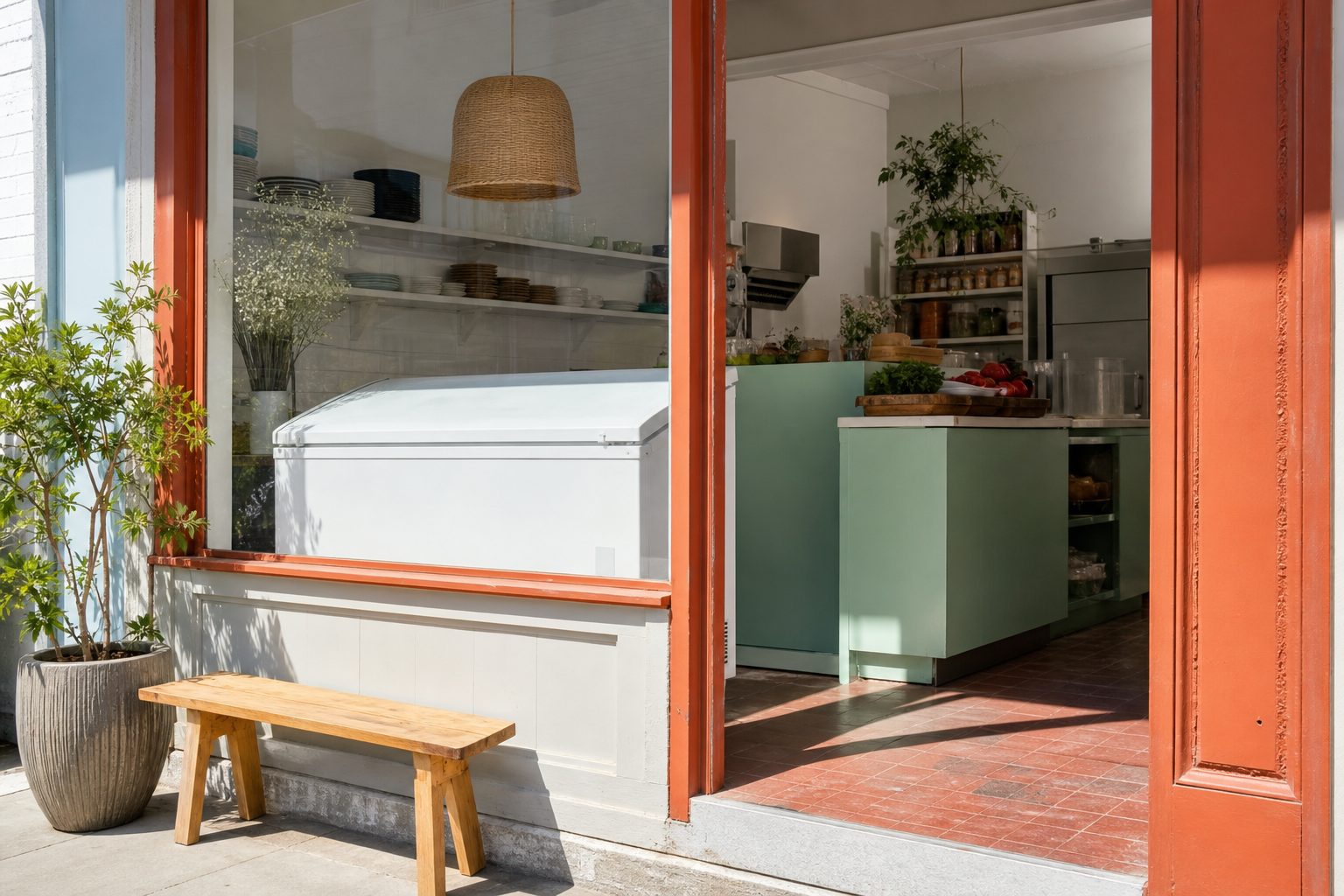
Yes, and the reason is structural rather than fashionable. The national meal kit model needs density to work, and a metro of two hundred thousand people does not supply it. A local frozen operation does not need density, because it is not paying for overnight refrigerated parcel shipping and it is not trying to acquire customers through national advertising.
Those two cost lines are most of the difference. Strip them out and the economics invert: the local kitchen with thirty stops in a six mile radius has a lower delivered cost per meal than a company shipping an insulated box across three states, even though the national company buys chicken cheaper.
The growth is not spectacular and it is not evenly distributed. It is steady, it is driven by household schedule pressure rather than by food trends, and it rewards operators who understand that their real competitor is the grocery store hot bar, not a meal kit brand.
Why national meal kit economics break outside dense metros
A shipped meal kit carries costs a local kitchen never touches.
- Insulated liners, gel packs or dry ice, and a corrugated box engineered to survive two days in a truck.
- Refrigerated or expedited parcel freight, priced by weight and distance, with a surcharge structure that penalizes rural and low density delivery zones.
- Regional fulfillment centers, which only pencil out when a large number of customers sit within economical shipping range.
- Paid customer acquisition at national media rates, against a customer base with high churn.
The packaging and freight portion of a shipped box is not a rounding error. Anyone who has priced insulated shippers and two day refrigerated freight knows it runs to a meaningful share of the box price, and it does not fall with scale the way food cost does, because it is a physics problem: cold food in transit needs mass, insulation and speed.
Now add churn. Meal kits historically sold on introductory discounts, and a customer acquired at a discount who cancels in the second month never repays acquisition cost. In a thin market you cannot make that up on volume, so the rational move is to withdraw the zone. That is why coverage maps thinned out rather than expanded.
Keep reading: Do I need a commercial kitchen license to sell frozen family meals from my home state?
The cost advantages a local frozen operation actually holds
Run the same delivery cost from the other side, using assumptions you can substitute with your own numbers.
Assume a route of 30 stops, 45 miles, three hours including loading, a driver at $22 per hour fully loaded, and vehicle cost at the IRS standard mileage rate of 70 cents per mile for 2025, which is a reasonable stand in for fuel, wear and insurance.
| Line | Amount |
|---|---|
| Driver, 3 hours at $22 | $66.00 |
| Vehicle, 45 miles at $0.70 | $31.50 |
| Route total | $97.50 |
| Per stop, 30 stops | $3.25 |
| Per meal, 5 meal box | $0.65 |
Sixty five cents a meal to deliver. Compare that to any insulated shipper plus refrigerated freight and the gap is not close. The other advantages follow from the same locality.
- Frozen meals hold for weeks, so a missed delivery is a rescheduling problem, not a spoilage loss.
- Packaging is a lidded tray, not a cold chain system.
- Customer acquisition is a school newsletter, a clinic waiting room and word of mouth, not an ad auction.
- Production is made to order against a known list, so waste sits in the low single digits rather than being forecast against a national demand curve.
The national operator's advantage is procurement. Yours is that almost nothing between the pan and the customer's freezer costs you anything.
Household drivers: dual income schedules, aging parents, dietary needs
Demand here is not driven by people who want to eat differently. It is driven by people whose week does not have a cooking hour in it.
Three household types show up repeatedly in this business, and they buy for different reasons.
The compressed weeknight household
Two working adults, kids in evening activities, a window between 5:30 and 7:00 that has to cover pickup, homework and a meal. They are not price shopping against groceries. They are price shopping against takeout, which is a much higher bar to clear.
The adult child buying for a parent
This is the quietly growing one and it is demographic rather than cyclical. An adult buys a standing weekly order for a parent living alone forty minutes away. The buyer and the eater are different people, which changes everything about how you communicate: the buyer wants confirmation of delivery and portion appropriateness, the eater wants something easy to heat and not too much of it.
The medically constrained household
Low sodium after a cardiac event, renal diets, gluten free for diagnosed celiac, texture modified meals after a surgery. These households have real constraints, few good retail options, and very low churn once they trust you. They are also the households where allergen and ingredient documentation is the product, not a compliance chore.
Keep reading: How do I price a five meal weekly family box so it still clears thirty percent food cost?
Grocery and retail prepared foods as the real competitor
Operators who benchmark themselves against meal kit pricing are aiming at the wrong target. The customer deciding on Tuesday at 5pm is choosing between your tray, a rotisserie chicken with a bagged salad, the grocery deli case, and a delivery app.
Compete on the axes where retail is structurally weak.
- Portion honesty. A family sized retail tray is often two adult portions and a lie. Your portions are weighed.
- Ingredient transparency. A store prepared tray rarely lists what is in the sauce. Yours can list everything.
- Sodium and additives. Retail prepared food leans hard on sodium and preservatives for shelf life. Frozen does not need to.
- Repeatability. The store's rotation changes without notice. Your rotation is published.
- No trip. The tray is already in their freezer on Tuesday, which is the entire proposition.
Do not try to compete on price per ounce against a loss leading rotisserie chicken. You will lose, and it is not the comparison the customer is actually making.
Corporate, clinic and postpartum referral channels
Direct to consumer growth is slow and linear. Referral channels arrive in blocks, and mid sized towns are where they are easiest to build because the referrers are reachable in person.
Three that work.
- Postpartum. Doulas, lactation consultants, midwifery practices and hospital family birth centers. Meal support is a standard gift in this moment, and a two week or four week package is an easy thing for a friend group to buy together. Build a gift purchase path where the buyer and the recipient are different people.
- Clinical. Oncology infusion centers, cardiac rehab programs, dietitians in private practice and bariatric clinics. These generate low churn customers with specific requirements. Bring a sodium and macro breakdown, not a menu photo, and be honest about what you cannot certify.
- Employer. Small local employers, especially clinics, plants and firms with shift workers, buying weekly boxes as a benefit or a wellness line item. One account can be twenty standing orders on a single delivery point, which is the best route economics you will ever see.
Each of these requires paperwork you would otherwise skip: ingredient statements, allergen documentation, nutrition figures. That is the entry cost, and it is also the thing that keeps casual competitors out.
See how FreezerFive handles this for meal prep and freezer meal businesses
Cold chain infrastructure and where it limits expansion
The constraint on geographic growth is not demand. It is temperature.
Frozen delivery works up to the point where the last box in the vehicle is still solidly frozen at the last stop. That sets a practical route ceiling, driven by ambient temperature, insulation quality, how often the doors open and whether you run a freezer van or insulated totes with dry ice.
Beyond that radius the options all cost real money: a second van and driver, a satellite freezer as a drop point, or pickup locations hosted by a partner business with freezer space. A gym, a farm store or a church with a chest freezer can extend your map by twenty miles for the price of the freezer and a small monthly fee.
Summer compresses everything. A route that is comfortable in February can be marginal in August, and August is when a thawed and refrozen tray becomes both a quality complaint and a food safety issue. Plan the summer route first and let winter be easy.
Positioning a single kitchen for the next few years
The defensible position is not being the cheapest frozen meal in town. It is being the operation that a specific set of households cannot easily replace.
Pick a constraint you serve better than anyone within fifty miles: a genuinely low sodium line, reliable allergen documentation, senior appropriate portions, a postpartum package that a friend group can buy in three clicks. Publish your rotation so people can plan around it. Keep your route tight and your delivery window honest. Grow by adding stops inside the radius you already drive, not by extending the radius.
Making the week run
All of that rests on knowing, early, exactly what this week's orders require: the ingredient totals, the allergen flags, the stops grouped into a route that holds temperature.
FreezerFive handles that specific job. Customers order from the menu you set, the system scales the ingredients, prints the pick list and groups the deliveries, so the growth you win in your own town does not turn into a Sunday night spent doing arithmetic.
Read also
Do I need a commercial kitchen license to sell frozen family meals from my home state?
Cottage food laws almost never cover frozen entrees. Here is how state retail food establishment licensing, commissary agreements and shared kitchen leases actually apply to a freezer meal operation.
How do I price a five meal weekly family box so it still clears thirty percent food cost?
Build the price from the plate up: costed recipes, yield loss, packaging, labor per pan and delivery. A worked example for a five entree box serving a family of four.
How many pounds of chicken should I thaw for forty orders without wasting a case?
Thaw math starts with portion weight, multiplies by orders, then adds yield loss and a safety margin. A step by step method plus the refrigerated thaw timing that keeps you legal.